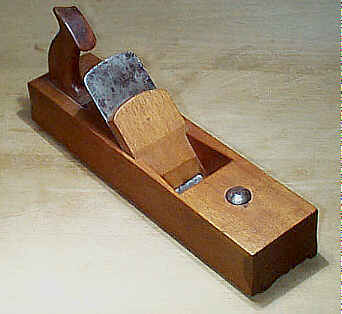
Hey, didja know that Sister Tabitha Babbit, of the Harvard, Massachusetts Shaker community, invented the circular saw as she sat there at her spinning wheel watching some of her Brother Shakers toiling while they cut wood? Come on, get real. Talk about urban legend. Sister Babbit invented nothing but a yarn.
But, Hosea Edson, a communal commrade of Sister Babbit, did make the plane pictured here. How do I know that? It says so right on the toe's endgrain and is as plain as the nose on your face, "HOSEA EDSON/HARVARD". Ok, there could have been some other dude named Hosea Edson either living in Harvard or maybe even a graduate of that universty located in 'Moscow on the Charles.' Yeah, but a quick visit to the Shaker Cemetary, right there in Harvard, MA, quickly puts to rest who actually made this plane. Hosea is mouldering there right along with the rest of the celibates. They all have grave markers, and his, oddly enough, reads "HOSEA EDSON 1753-1829".
Edson slipped in and out of the Shaker community over his later years. Prior to joining them, he fought in the Revolution by answering the Lexington Alarm (you know, the British are coming, etc.....).
This plane is a cornice plane, and cuts a molding (ogee, square, reverse ogee) that measures 2 3/4" wide. This profile was commonly used in architecture and furniture. It's unlikely that this plane was used for furniture as it's much too ornate for the austere Shaker design. Thus, it's probable that the plane was used for architectural purposes. It may even be that the plane was made by Edson for sale to the outside world. If that's the case, the plane was scarcely used as it's in a remarkable state of preservation despite the common chip on the tote.
The plane measures 13 1/2" long. Its stock is made of yellow birch, the wood of choice for planes in 18th century New England. The tote is made of a fruitwood, probably applewood. A metal strike is affixed to the stock before the iron so that it may be struck with a mallet to remove the wedge without injuring the stock.
pal, February 17, 1998